The Liquid Gold Phenomenon
Why pure peanut butter separates — and why that layer of oil is the ultimate certificate of purity.
Read the Oil Slick Like a Label
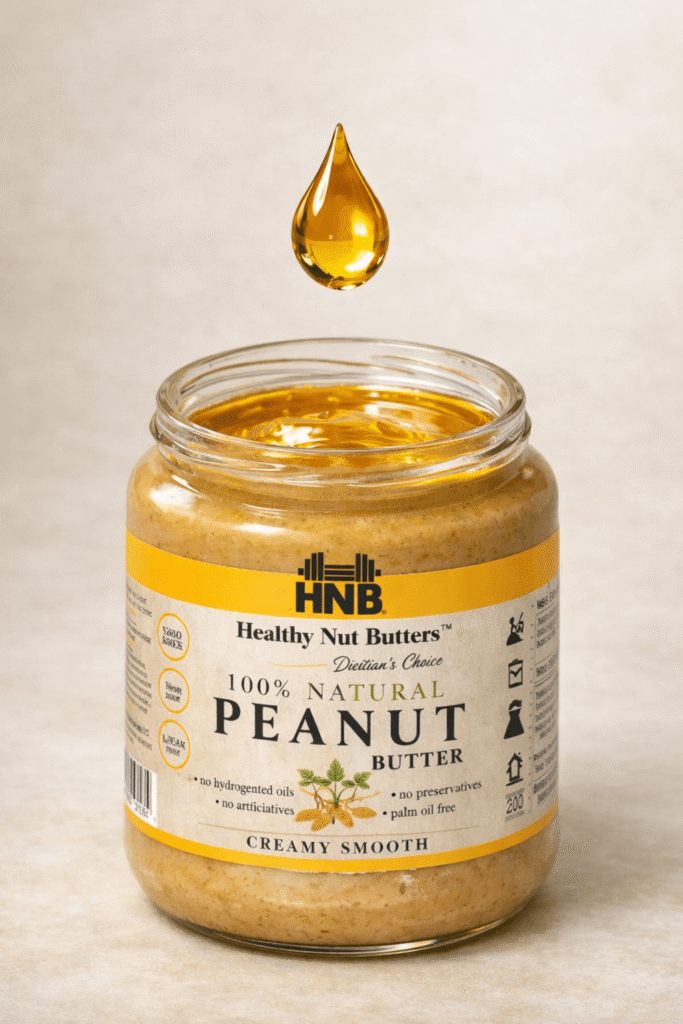
That little pool of oil floating on top of your jar isn't a flaw. It's a receipt. What you're looking at — peanut butter oil separation — is the single most reliable sign that nothing artificial was ever done to your food.
Most people see it and panic. They think the jar is broken, old, or cheap. They pour the oil down the drain. Every one of those instincts is wrong.
The truth is the opposite of what the marketing trained you to believe. The jar that separates is the honest one. The jar that stays flawlessly smooth, month after month, is the one with something to hide.
The Suspicious Part Is the Jar That Never Moves
Ask the real question: why doesn't commercial peanut butter separate? Because it's been engineered not to.
There are three usual tricks. Hydrogenation — pumping hydrogen into the oil to turn it semi-solid so it can't rise. Palm oil, layered in to hold everything in suspension. Or emulsifiers and stabilizers that lock the texture in place.
The first one has a dark history. Hydrogenation is how the food industry created artificial trans fats — and the U.S. FDA eventually ruled partially hydrogenated oils were no longer safe to add to food, because they raise "bad" LDL cholesterol (FDA, Trans Fat). Here's the kicker: hydrogenated oil was once a legally permitted ingredient in peanut butter, until the FDA struck it from the recipe's standard of identity (FDA, 2018). So if your jar never separates, ask what's keeping it still.
Why Peanut Butter Oil Separation Happens (In Plain English)
Forget the jargon. Here's the whole thing in one breath: a peanut is about half oil, that oil is liquid at room temperature, and liquid oil is lighter than ground peanut solids. So it floats. Gravity does the rest.
That's it. Peanut butter oil separation is just physics — light oil rising above heavier solids, the same way oil rises above vinegar in a salad dressing you forgot to shake. Nothing is spoiling. Nothing is wrong.
Hydrogenation only "fixes" it by making the oil solid so it can't float (the FDA quote for it: a process that turns vegetable oil "into a solid fat at room temperature"). Take that away, and nature takes over. The oil rises because it's free — unbound by any additive.
Here are the questions everyone actually asks:
- Is it spoiled? No. Separation is normal and expected in pure peanut butter. (Rancid is different — that's a sharp, paint-like smell after long storage. Separation has no smell.)
- Do I throw the oil away? Never. That oil is flavor and heart-healthy unsaturated fat. Pour it off and the rest turns dry, dense, and hard to spread.
- Why is the bottom so stiff? Because the oil that should be in it floated to the top. Stir it back down and the whole jar softens.
- Does more oil mean lower quality? Usually the reverse — it means fewer additives holding it together.
How to Tame It, Elegantly
You don't fight the oil. You fold it back in. A few small habits make it effortless:
- Store the jar upside down for a day before opening — the oil migrates back through the solids on its own.
- Stir it once, properly, the first time you open it. A long knife or a folding motion beats frantic stirring.
- Refrigerate after mixing. Cold slows the oil from re-separating and keeps the blend even. Just let it sit out a few minutes before spreading.
That's the entire skill. We get into which additives signal the opposite of purity in natural vs commercial peanut butter, and the broader quality case lives in our pillar on whether peanut butter is healthy.
It's exactly why our editorial pick separates with pride — the HNB 100% Classic Peanut Butter is peanuts and nothing else, so of course the oil rises. The slick on top is the proof, not the problem.
The Closing Thesis
The Takeaway: We have been trained to mistake "perfectly smooth, forever" for quality, when it's usually the fingerprint of something added. Peanut butter oil separation is the honest jar showing its work — pure oil, free to rise, because nothing was put in to pin it down. Stir it in, store it smart, and enjoy it. That golden layer on top isn't the thing to wipe away. It's the thing that tells you you bought the real one.
JOIN THE READING CLUB
Get new articles, recipes, and member-only offers - straight to your inbox.